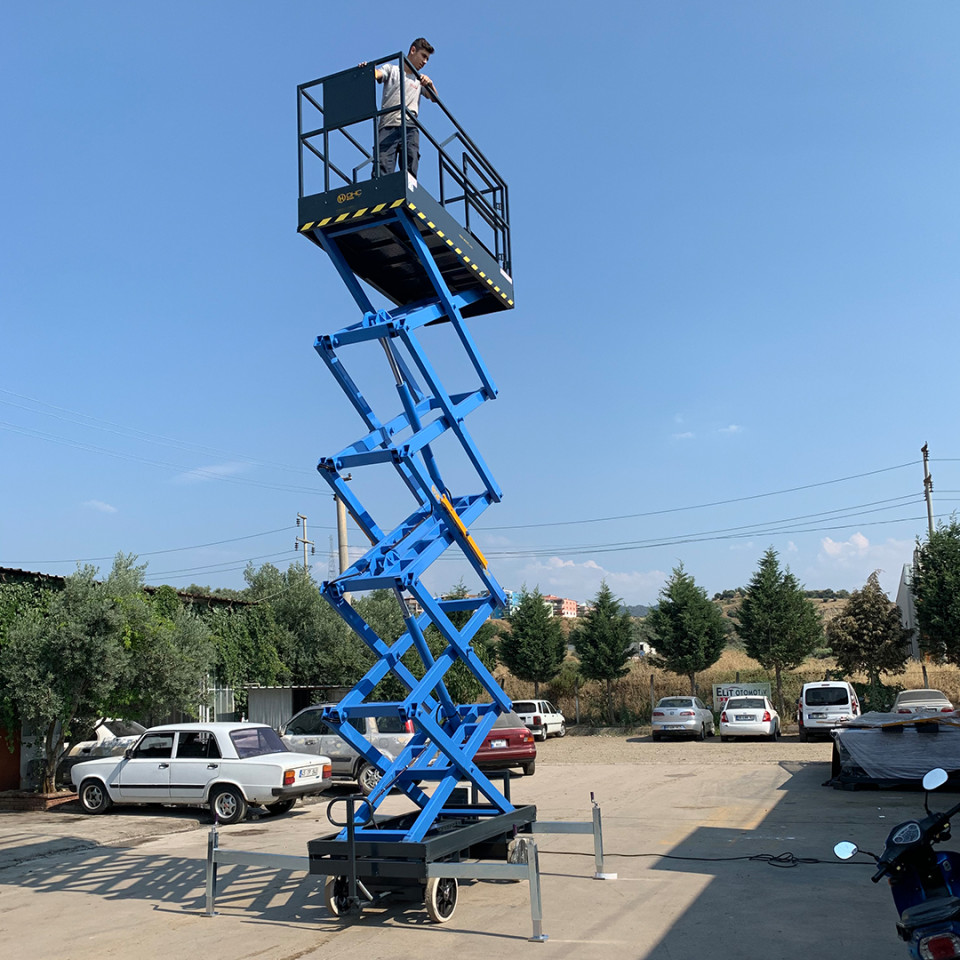
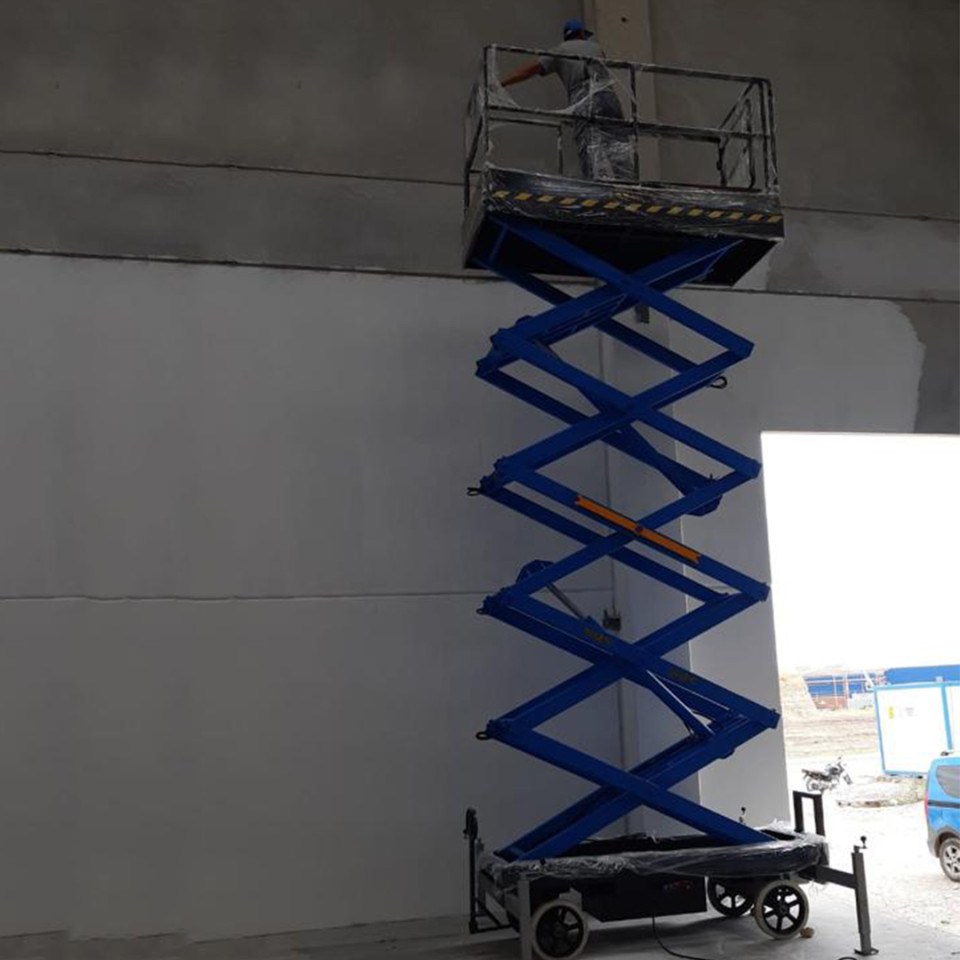



OHC Lift aerial work platforms provide a stable working area for installation, maintenance, repair, inspection and cleaning tasks at height. Their compact footprint and practical manoeuvrability make them suitable for construction sites, warehouses, factories, shopping centres, stadiums, facilities and building services. The platform helps teams reach elevated work points in a controlled manner while carrying the tools and light materials required for the task.
Aerial Work Platform
An aerial work platform, also known as a personnel lift or manlift, is designed to raise operators to a defined working height. Unlike improvised access equipment, the platform provides a guarded work area and a lifting mechanism engineered for controlled vertical movement. Depending on the application, the equipment can be moved manually between work points and stabilised before lifting.
OHC Lift personnel platforms are designed through mechanical, hydraulic and electrical engineering calculations. The steel structure, platform dimensions, lifting capacity and maximum working height are selected according to the intended operating conditions. Standard models are available for different working heights, while project-specific requirements can also be evaluated.
Where Are Personnel Lifts Used?
Personnel lifts are widely used for electrical and mechanical installation, lighting maintenance, shelving and warehouse operations, façade work, painting, insulation, cleaning, signage, facility maintenance and production-line support. Compact dimensions are especially valuable in areas where scaffolding is impractical or where work points change frequently.
For indoor operations, the floor condition, access doors, aisle width and available electrical supply are considered. For outdoor work, ground stability, wind conditions and the required stabilisation area must be assessed before operation. The selected model must always be used within its rated capacity and working-height limits.
How Does an Aerial Work Platform Operate?
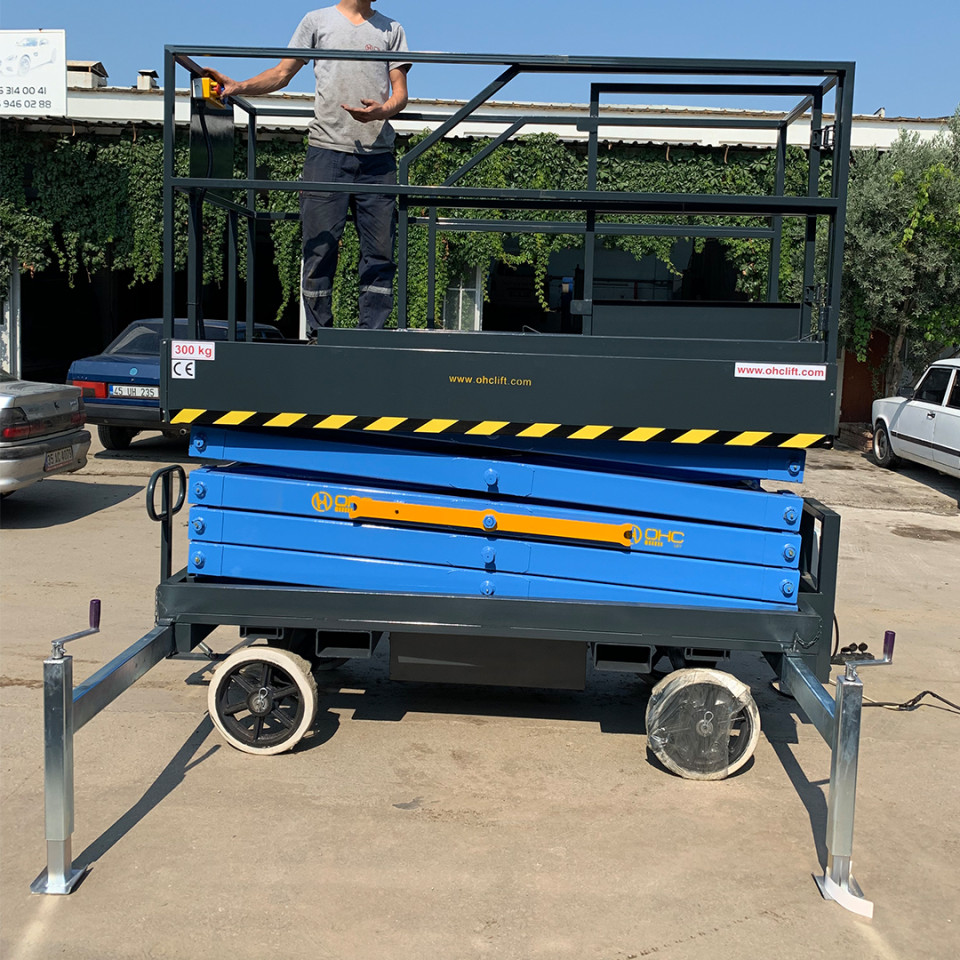
The lifting mechanism raises the work basket by means of an electrically powered hydraulic system. Controls are provided both on the platform and at ground level, allowing the movement to be managed from the appropriate position. Before lifting, the machine is placed on a stable surface and the outriggers are deployed and adjusted. Once the working area is secured, operators can raise or lower the platform with the push-button controls.
The extending deck provides additional horizontal reach for suitable tasks. When the work is complete, the platform is fully lowered, the extension is retracted and the outriggers are returned to their transport position. The unit can then be moved to the next location using the steering and wheel system.
Standard Features
- CE-compliant design and manufacturing for the applicable product configuration.
- Durable steel structure developed with engineering calculations.
- High-quality hydraulic and electrical circuit components.
- Low-voltage 24 V DC control circuit for operational safety.
- Dual control stations on the platform and at ground level.
- Electrical socket inside the work basket for compatible tools.
- Non-marking solid rubber wheels and a high-manoeuvrability steering system.
- Quality bushes, grease points and sealed bearings in moving components.
- Fork pockets for convenient loading and transport by forklift.
- Extendable deck offering approximately one metre of additional reach.
- Protected control cables routed within the scissor structure.
- Four adjustable outriggers for secure positioning on suitable uneven surfaces.
Safety Systems
A hose-burst valve helps prevent sudden descent if a hydraulic hose is damaged. A pressure relief valve protects the hydraulic circuit against overload, while an emergency manual-lowering function allows the basket to be brought down during a power failure or system fault. Audible and visual warning devices indicate lifting and lowering movement.
These systems support safe operation but do not replace correct training, pre-use inspection and compliance with the operating manual. The working area must be isolated from traffic, the rated load must not be exceeded and occupants must not climb on the guardrails. Periodic inspections and planned maintenance should be performed by qualified personnel.
Model Selection and Technical Criteria
The correct personnel platform is selected according to working height, platform height, basket dimensions, machine width, access restrictions, required capacity and available power supply. OHC Lift CP-series configurations include alternatives for approximately 8 m, 10 m and 12 m working heights, with a 300 kg main-platform capacity in the referenced standard range. Exact values must be confirmed for the selected model and project.
Other important criteria include the closed and stabilised footprint, total machine weight, floor load, extension-deck capacity, lifting time and transport method. Providing accurate site measurements allows the engineering team to recommend the most suitable configuration.
Advantages of Personnel Platforms
A well-selected platform reduces the time required to reach elevated work points and provides a more organised working area for operators, tools and materials. It can be relocated as tasks progress, supports repeatable vertical access and helps reduce the need to assemble temporary structures for short-duration work. The guarded basket, controlled motion and emergency functions contribute to a safer working process when the equipment is used correctly.
Request a Project-Specific Quotation
For an accurate recommendation, share the required working height, number of operators, tools and material weight, indoor or outdoor use, access dimensions, floor conditions and power availability. OHC Lift will evaluate the application, select the appropriate personnel platform and prepare a quotation based on the required technical configuration.
- Our products are CE Certified in accordance with the standards.
- It is a manually pulled type platform.
- Operating Voltage 380 V AC
- Durable steel construction designed with Engineering Calculations
- High quality hydraulic and electrical circuit components
- Safety in the control circuit with 24 V DC Control Circuit
- Double Control System (Button Control System in Basket and Body)
- 220 V Socket in a Basket
- Non-marking solid rubber wheels
- Highly maneuverable steering Wheel
- High quality steel outer bushes and high quality teflon coated inner bushings on shears
- Bushing Grease Fittings
- Closed Type Bearings in Rotating Parts (No lubrication required)
- Forklift sleeves for forklift transport
- Additional 1 m working flexibility with the Extendible Additional Platform
- Control cables hidden in scissors
- Preventing the sudden drop of the platform in hydraulic hose explosion with hose explosion valve
- Overload prevention with safety valve
- Manual Basket Landing (Hydraulic lowering the basket in case of power failure or failure)
- Warning system during take off and landing with audible and visual flasher
- 4 Balance Legs that open to the side. (Secure fixing on unstable ground thanks to height adjustment)
Product Code | CP.12 | CP.10 | CP.8 |
Working Height | 12 m | 10 m | 8 m |
Raised Platform Height | 10 m | 8 m | 6 m |
Lowered Platform Height | 1,4 m | 1,2 m | 1,1 m |
Platform Sizes | 2,35×1,0 m | 2,35×1,0 m | 2,35×1,0 m |
Machine Width – Closed | 1,0 m | 1,6 m | 1,6 m |
Machine Width – Open | 2,5 m | 2,30 m | 2,2 m |
Additional Platform | 1,0 m | 1,0 m | 1,0 m |
Railing Height | 1,1 m | 1,1 m | 1,1 m |
Capacity | 300 kg | 300 kg | 300 kg |
Additional Platform Capacity | 125 kg | 120 kg | 120 kg |
take off and landing time | 80/90 sec. | 80/90 sec. | 80/90 sec. |
Engine | 2,2 kw / 380 V AC | 2,2 kw / 380 V AC | 2,2 kw / 380 V AC |
Wheels | 400×75 mm | 400×75 mm | 400×75 mm |
Control System | Push button | Push button | Push button |
Total Weight | 1.650 kg | 1.400 kg | 1.250 kg |
Lifting System | Electric | Electric | Electric |
Walking System | Manuel | Manuel | Manuel |